Nov 8, 2025 · 5 min read
Outlasting the Hustle
We live in an age of instant transformation. Thirty-day challenges promise to change your life. Viral success stories flood our feeds. Bootcamps claim to take you from zero to job-ready in twelve weeks. The narrative is clear: if you're not improving rapidly, you're doing something wrong.
But real growth isn't like that. Real growth is slow, invisible, and deeply unglamorous. It's the accumulation of small efforts over long periods. It's showing up when no one is watching, making progress that no one can see, trusting that something is happening even when the evidence suggests otherwise.
This is a love letter to slow growth. To the tortoises in a world obsessed with hares.
The Myth of the Breakthrough
We love breakthrough moments. The overnight success, the sudden insight, the dramatic transformation. We tell stories about these moments because they're compelling. They make for great movies, inspiring speeches, and viral tweets.
But breakthroughs don't come from nowhere. They're the visible result of invisible work. Years of practice, failure, and incremental improvement that finally reach a tipping point. The "overnight" success was ten years in the making.
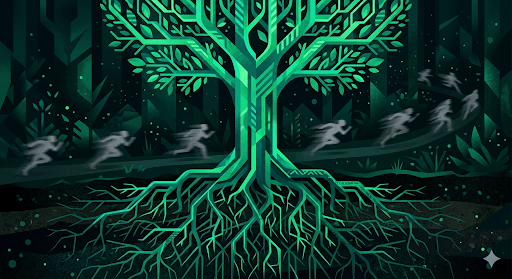
When we focus on breakthroughs, we miss the process. We see the flower blooming and forget about the years of root growth. We celebrate the mountain summit and ignore the thousands of steps it took to get there.
The Compound Interest of Skill
Skills compound like money in a savings account. Small, consistent deposits grow exponentially over time. But the early stages are discouraging. You put in effort and see almost no return. The balance grows slowly, almost imperceptibly.
This is where most people quit. The gap between effort and results feels too wide. The delayed gratification is too delayed. Why spend an hour practicing when you can't see any improvement?
But growth is happening, even when you can't see it. Neural pathways are forming. Muscle memory is developing. Concepts are slowly clicking into place. You can't observe these changes directly, but they're real.
The Plateaus Are Part of It
Skill development isn't linear. You improve rapidly at first, then hit a plateau. The plateau feels like stagnation, but it's actually consolidation. Your brain is integrating what you've learned, making it automatic, creating space for the next level.
Plateaus are frustrating. You practice the same things, make the same mistakes, feel like you're going nowhere. This is when the temptation to quit is strongest. Why keep doing something that isn't working?
But plateaus end. Eventually, something shifts. The skill that felt impossible becomes possible. The concept that seemed foreign becomes familiar. And you realize the plateau wasn't empty time — it was necessary processing.
Learning to Love the Process
If you're only in it for the results, slow growth is torture. The gap between where you are and where you want to be seems impossibly wide. Every day of practice feels inadequate. The progress is too slow to be satisfying.
But if you learn to love the process itself — the practice, the learning, the gradual mastery — then slow growth becomes sustainable. The daily work becomes its own reward. The destination matters less because the journey is meaningful.
This is easier said than done. We're wired for immediate rewards. Our brains evolved to prioritize quick wins over long-term gains. Loving the process requires rewiring some deep programming.
The Social Media Distortion
Social media makes slow growth harder. Everyone is posting their wins, their transformations, their before-and-afters. No one posts the thousand unremarkable days in between.
This creates a distorted picture of what progress looks like. You see the highlight reel and compare it to your behind-the-scenes. Their breakthrough moments against your daily grind. Their results against your process.
It's not a fair comparison. But more importantly, it's not a useful comparison. Their timeline isn't your timeline. Their path isn't your path. The only meaningful comparison is you today versus you yesterday.
The Invisible Improvements
Some of the most important growth is invisible. Increased resilience. Better emotional regulation. Improved ability to handle uncertainty. These don't show up in metrics or photos, but they change everything.
I think about my own coding journey. The early years were marked by visible milestones — building my first website, learning a new language, shipping a project. But the real growth was invisible. Learning to debug patiently. Handling frustration without quitting. Knowing when to ask for help.
These invisible skills don't make for impressive updates. But they're the foundation that makes everything else possible.
Quantity Leads to Quality
There's a theory about creative work: quantity leads to quality. The more you produce, the more likely you are to produce something good. This only works if you embrace slow growth.
Your first hundred attempts will mostly be bad. That's not pessimism; it's statistics. But attempt number one hundred and one might be different. And you only get there by doing the hundred that came before.
Ira Glass has a quote about this: "Nobody tells this to people who are beginners... all of us who do creative work, we get into it because we have good taste. But there is this gap. For the first couple years you make stuff, it's just not that good. It's trying to be good, it has potential, but it's not."
The gap is real. The only way across is through.
The Long Now
I try to think in decades. Where do I want to be in ten years? Twenty? This long-term perspective changes how I approach daily work. Small improvements compound over time. The person I'll be in ten years is being built by the habits I practice today.
This thinking also reduces pressure. I don't need to master everything today. I don't need to be impressive today. I just need to make small progress. The rest will come in time.
The long now mindset also helps with comparison. That person who's ahead of you? They might have started earlier. Their day one might have been your year negative five. Their head start isn't your failure.
Trusting the Process
There's a leap of faith involved in slow growth. You have to trust that effort accumulates, even when you can't see it. You have to believe that consistency matters, even when the results are invisible.
This trust is hard to maintain. Doubt creeps in. Maybe this isn't working. Maybe I'm wasting my time. Maybe I should try something different, something that promises faster results.
But the alternatives — jumping from thing to thing, chasing quick wins, abandoning work before it compounds — don't work either. Slow growth might be slow, but it's real. Fast growth is often illusion.
The Tortoise Wins
We know how the fable ends. The tortoise wins. Not because he's faster, but because he doesn't stop. The hare sprints, rests, gets distracted. The tortoise just keeps moving.
Most of us want to be the hare. We want bursts of inspiration, periods of intense productivity, dramatic transformations. But the tortoise has the better strategy. Slow, steady, relentless progress beats sporadic brilliance every time.
So this is my commitment to slow growth. To showing up, even when the results are invisible. To trusting the process, even when doubt creeps in. To being the tortoise in a world of hares.
The growth is happening. I just can't see it yet.
Thanks for reading. If this resonated with you, I'd love to hear about what you're building. Get in touch.