May 20, 2025 · 3 min read
Subtracting the Noise
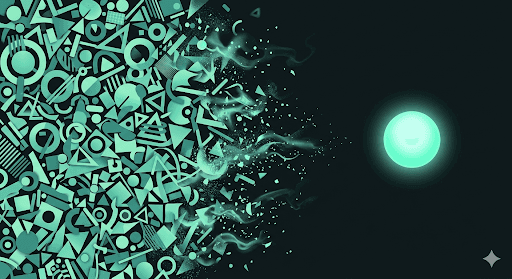
I used to think that complexity was a sign of sophistication. The more features a thing had, the more options it offered, the better it must be. I collected apps with endless settings, subscribed to services with dozens of features, and built projects that tried to do everything at once.
It was exhausting. And unnecessary. And, worst of all, ineffective.
The Seduction of More
We live in a culture of more. More features, more options, more customization. The logic seems sound: if some is good, more must be better. But it rarely works out that way.
Every feature you add is a decision someone has to make. Every option is a question that needs answering. Every customization is a setting that can be wrong. Complexity doesn't just make things harder to use — it makes them harder to choose.
I think about this every time I open a settings menu with fifty toggles. I came here to change one thing. Now I'm questioning every choice I've ever made. Is this the optimal configuration? Am I using this tool wrong? The anxiety of optimization creeps in, and suddenly I'm not working anymore — I'm tweaking.
Learning to Subtract
The hardest part of simplicity isn't knowing what to include. It's knowing what to leave out. Every project starts with ambition. Wouldn't it be cool if it did this? And this? And what about this edge case that only affects 0.1% of users?
Before you know it, you've built a monstrosity. It does everything, but it does nothing well. Users are confused. You're exhausted. And the original purpose — the one thing you set out to do — is buried under layers of well-intentioned features.
I've learned to ask a different question: what can I remove? Not what can I add, not what would be nice to have, but what can I take away without breaking the core purpose?
The answer is usually: a lot more than you think.
The Beauty of Constraints
Constraints are often seen as limitations. But I've come to see them as creative fuel. When you can't do everything, you're forced to choose what matters. And that choice — that deliberate, sometimes painful choice — is what creates focus.
Twitter's original 140-character limit wasn't a bug; it was a feature. It forced brevity. It made people edit ruthlessly. It created a format that was distinct, memorable, and surprisingly expressive.
I try to apply this thinking to everything I build. What's the constraint that will force creativity? What's the limitation that will make this better, not worse?
Simple is Hard
Here's the paradox: simple is harder than complex. Anyone can add features. It takes skill to remove them. Anyone can handle the happy path. It takes thought to eliminate the edge cases.
When you build something simple, every decision matters more. There's nowhere to hide. Each element has to justify its existence. If it doesn't serve the core purpose, it goes.
This is scary. It means saying no to things that might be useful. It means disappointing people who want that one extra feature. It means accepting that your thing won't be everything to everyone.
But it also means clarity. It means purpose. It means building something that knows what it is and doesn't apologize for what it isn't.
Simplicity in Life
This isn't just about software. I try to apply the same thinking to my life. Fewer possessions, fewer commitments, fewer things competing for my attention.
It's not about deprivation. It's about space. When you clear away the clutter — physical, digital, mental — you create room for what actually matters.
I've simplified my wardrobe to a few basics that work together. I've simplified my diet to meals I enjoy that don't require much thought. I've simplified my schedule to protect the blocks of time when I do my best work.
Each simplification was a small act of rebellion against the cult of more. And each one gave me something back: time, energy, clarity.
The Eternal Temptation
I still slip. I still see a new tool and think, "Maybe this will solve all my problems." I still start projects with too much ambition and have to ruthlessly cut them back. I still occasionally find myself in settings menus, tweaking things that don't need tweaking.
Simplicity isn't a destination. It's a practice. You don't achieve it and move on; you have to keep choosing it, day after day, project after project.
But the effort is worth it. Because when you strip away the unnecessary, what's left is something pure. Something focused. Something that actually works.
And that's worth more than any number of features.
Thanks for reading. If this resonated with you, I'd love to hear about what you're building. Get in touch.